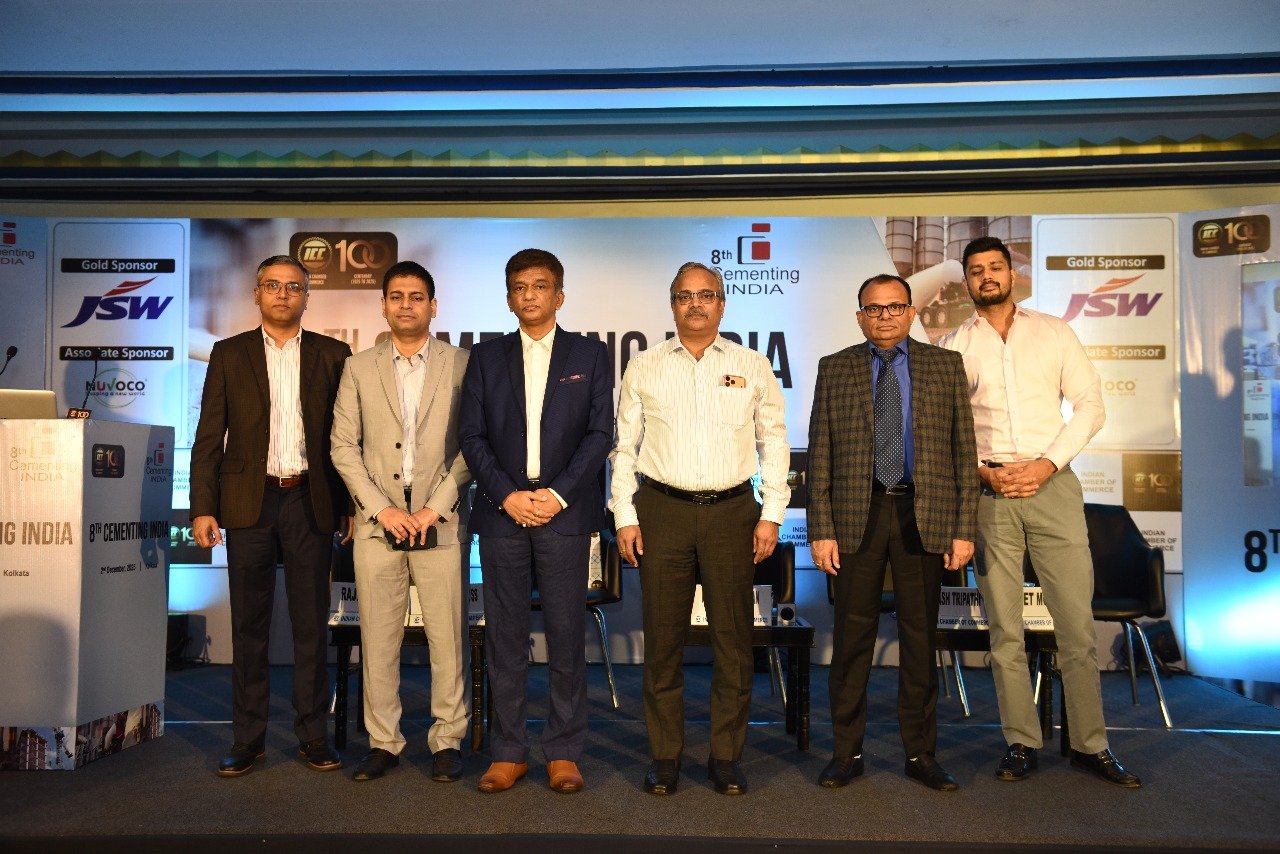
Kolkata, December 03, 2025: India’s cement industry is entering a decisive new phase driven by tighter environmental regulation, rapid capacity expansion, and a push towards green technologies and digitalisation, industry leaders said at the 8th Cementing India Conference hosted by the Indian Chamber of Commerce (ICC). The high-level forum on technological and environmental developments brought together senior leadership from manufacturing, real estate, sustainability and consulting to outline the future roadmap of the sector amid India’s accelerating infrastructure growth.
Highlighting the regulatory shift, Hemanth Kumar, Vice President, Birla Corporation, said recent amendments to the Air (Prevention and Control of Pollution) Act have, for the first time, made industrial siting norms legally enforceable. “Until three years ago, there were no defined location criteria. Today, guidelines have become binding rules,” he said. Under the new framework, red-category industries must operate more than 500 metres from water bodies and settlements, while orange-category units must maintain over 75 metres where effluents are discharged, 30 metres where they are not, and more than 200 metres from settlements. Green-category industries must be at least 30 metres away from water bodies and 100 metres from residential areas. Kumar added that environmental protection is now central to project approvals, supported by mandatory Online Continuous Monitoring Systems for real-time pollution data. He said green-belt norms have also been revised to 25% for red industries, 20% for orange and 10% for green industries. At Birla Corporation, he noted, nearly 80,000 plantation activities were carried out in the past year, including Miyawaki plantations around Chittoor and mine reclamation at Sanmaniyan. “We have achieved plastic-neutral operations and three-times water-positive status,” he added, citing rainwater harvesting at reclaimed limestone mines in Durgapur.

Santanu Adhikari, Cluster Technical Service Head–East, Adani Group said India now produces world-class cement, but “rural India, which consumes nearly 70% of cement, still struggles with access to modern skills and technology”. He said following the acquisition of ACC and Ambuja, the Adani Group expanded capacity from 70 million tonnes to 100 million tonnes in about 30 months, adding nearly one million tonnes every month. “More than seven lakh masons and contractors have been trained through structured programmes. Quality systems cover 97 checkpoints, backed by digital tools, robotics, AI, sensors, XRD and cross-belt analysers. With 24 plants and over 100 RMC units nationwide, 95% of trade sales now come from green blended cement,” Mr Adhikari added.
Saket Mohta, Managing Director, Merlin Group said India is witnessing the fastest construction growth in its history. “Cement is the silent backbone of development. Choosing the right cement is an ethical responsibility that directly affects safety and trust,” he said. He added that blended cement, precast and modular construction, along with alignment to IGBC and GRIHA standards, are reshaping project timelines and sustainability benchmarks.
Meanwhile, Raju Ramachandran, Chief Manufacturing Officer (East) and Safety & Sustainability, Nuvoco Vistas Corp. Ltd said India’s cement capacity touched 631 million tonnes in FY24, with production at 417 million tonnes, but per-capita consumption of 250–270 kg signals vast growth potential. He said green cement and precast construction are key growth engines, with the green cement market at USD 1.5 billion and expected to double in 5–10 years. “Technologies such as LC3 and policy support for decarbonisation are changing the industry,” he said, adding that precast methods can cut project timelines by nearly six months.
India’s cement sector has reached a critical growth phase with capacity at 631 million tonnes in FY24, utilisation near two-thirds and production at about 417 million tonnes, driven by infrastructure, housing and rural demand, said Mr Rajib Maitra, Partner, Deloitte. “Yet per-capita consumption remains only 250–270 kg, far below Japan, Brazil and China, indicating massive headroom for growth,” he said. He added that green cement and precast concrete are emerging as the strongest growth drivers as the industry shifts toward low-carbon and faster construction. India’s green cement market, estimated at USD 1.5 billion, is expected to double in 5–10 years, supported by LC3 technology and policy measures such as PAT, CCTS, CCU missions and green procurement norms. Though India accounts for just 2% of the global precast market, the technology can shorten project timelines by nearly six months and support programmes such as PMAY-G and major infrastructure development.
Kailash Tripathi, Assistant Vice-President, Mangalam Cement Limited said the sector’s future will depend on how quickly companies adopt digital controls, improve resource efficiency and shift to cleaner production. Rajib Maitra said regulatory evolution and sustainability will increasingly define investment decisions.