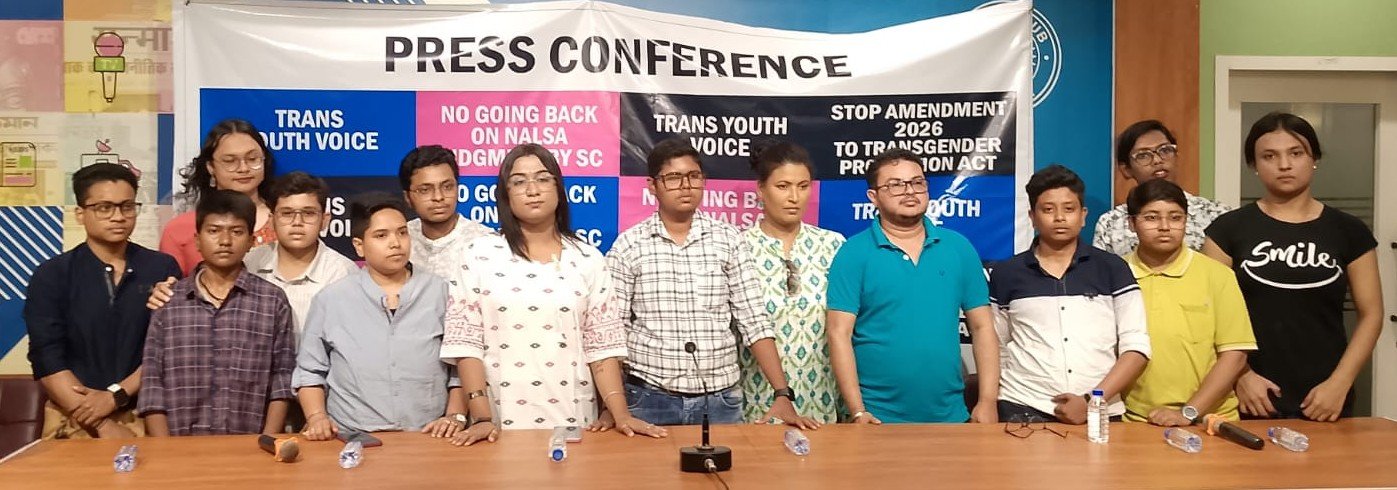
Kolkata, March 17, 2026: Members of the transgender youth community along with civil society allies on Tuesday raised concerns over the Transgender Persons (Protection of Rights) Amendment Bill, 2026, stating that the proposed changes could undermine the constitutional principle of self-identification recognised by the Supreme Court.
Addressing a press conference at the Kolkata Press Club, representatives of Transgender Adhikar Sanghati Manch (TAS) said the amendment, introduced in Parliament on 13 March 2026, was reportedly passed in the Lok Sabha through a voice vote without discussion, prompting serious concern within the community.
“Young transgender Indians have just begun entering mainstream life with dignity. Laws that weaken self-identification risk pushing them back into the very marginalisation they have fought so hard to overcome,” speakers said.

The press conference was addressed by Debangshi Biswas Chowdhury, Founder of TAS; Shaan Chowdhury, Co-Founder of TAS and a transgender man; Riyan Biswas, trans youth leader; Tista Das, transgender rights activist and actor; Dipan Chakrabarty, LGBTQ+ rights advocate and transgender man; Baitali Ganguly, Founder of Jabala Action Research Organisation, and Bappaditya Mukherjee, gender and rights activist and youth development practitioner. A message of solidarity was also shared by social reformer Alokananda Roy.
According to speakers, the proposed amendment seeks to revise the definition of “transgender person” under the Transgender Persons (Protection of Rights) Act, 2019, referring to specific socio-cultural identities such as hijra, kinner, aravani, jogta or eunuch, along with persons with intersex variations.
Community representatives expressed concern that such definitions could narrow the understanding of transgender identity and exclude many transgender persons who do not belong to these traditional communities.
Debangshi Biswas Chowdhury said the amendment risks weakening the constitutional progress achieved through the landmark NALSA v. Union of India (2014) judgment.
“The NALSA judgment recognised gender identity as a matter of personal autonomy and dignity. Any move to weaken the principle of self-identification risks reversing years of struggle by the transgender community.”
Shaan Chowdhury, a transgender man, shared his personal journey.
“As a young person I had to give up football because my family feared social stigma. The journey towards living openly has been difficult. If identity recognition depends on medical boards or administrative approval, it will make life even harder for transgender youth.”
Dipan Chakrabarty criticised the proposed amendment.
“This bill denies the constitutional rights of transgender persons as citizens of India. A socio-cultural institution cannot define gender identity, yet this bill attempts to impose such definitions.”
Tista Das warned about the human rights implications.
“The Transgender Persons Protection Act Amendment 2026 is a negative and anti-human rights bill. If it becomes law, it will create grave dangers for the entire transgender community.”
Speakers emphasised that the Transgender Persons (Protection of Rights) Rules, 2020 currently allow legal recognition of transgender identity through an affidavit submitted to the District Magistrate, without medical examination.
They urged the Government of India to withdraw the proposed amendment and ensure that any legislative changes affecting transgender persons are undertaken in consultation with the community and in alignment with the constitutional protections affirmed by the Supreme Court.
The speakers concluded by reiterating that there can be “No Going Back on the NALSA Judgment.”