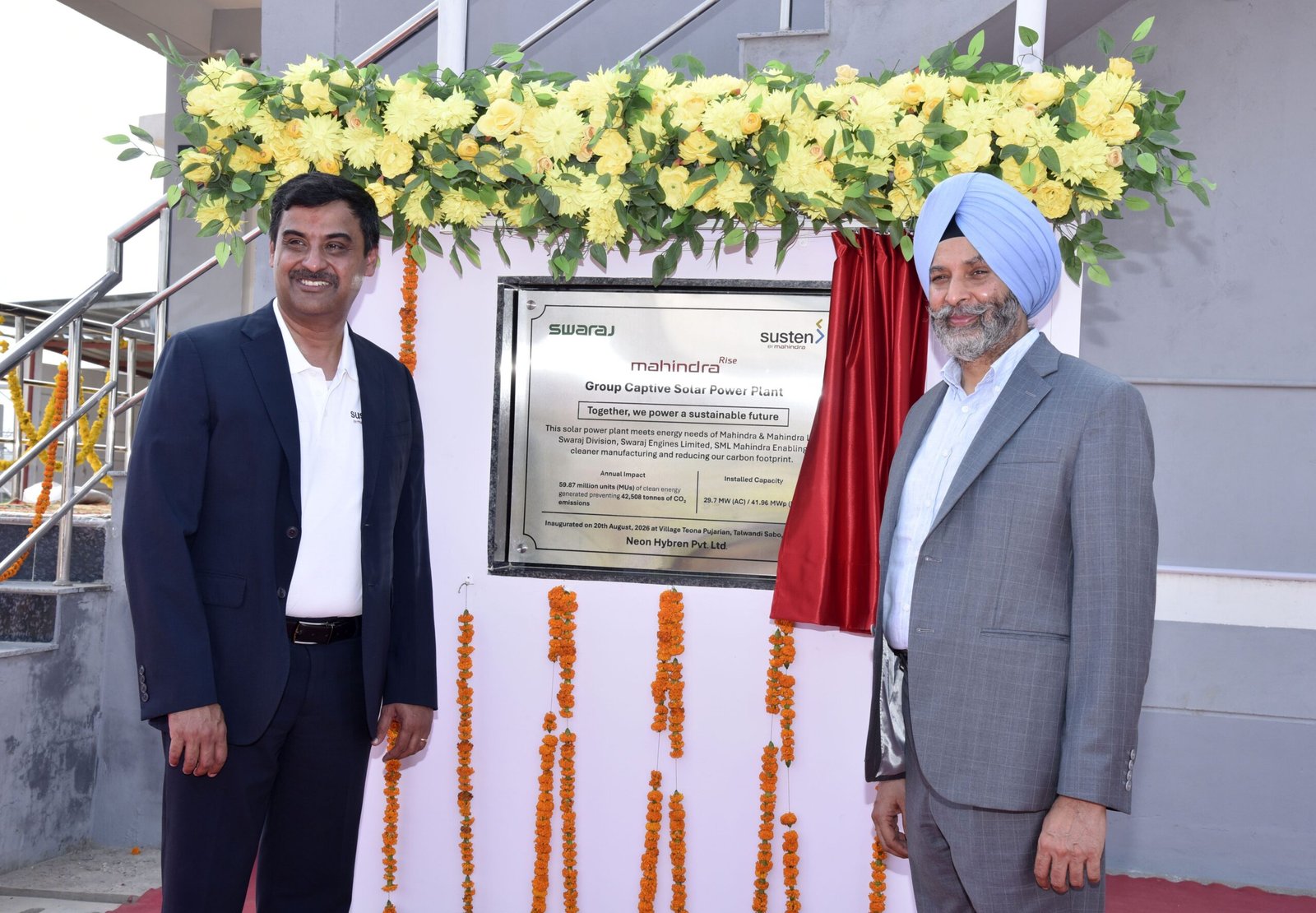
National, September 2, 2026: Swaraj Tractors, part of the Mahindra Group, and Mahindra Susten, the Group’s renewable energy platform and Independent Power Producer, today announced the commissioning of a 42 MWp group captive solar project in Bathinda, Punjab. The project is among the largest group captive solar installations of its kind in the state.
The project is expected to meet around 50% of the electricity requirements of Swaraj Tractors’ manufacturing facilities, marking a major milestone in the company’s broader strategy to build a future-ready, low-carbon manufacturing ecosystem aligned with the Mahindra Group’s sustainability commitments.
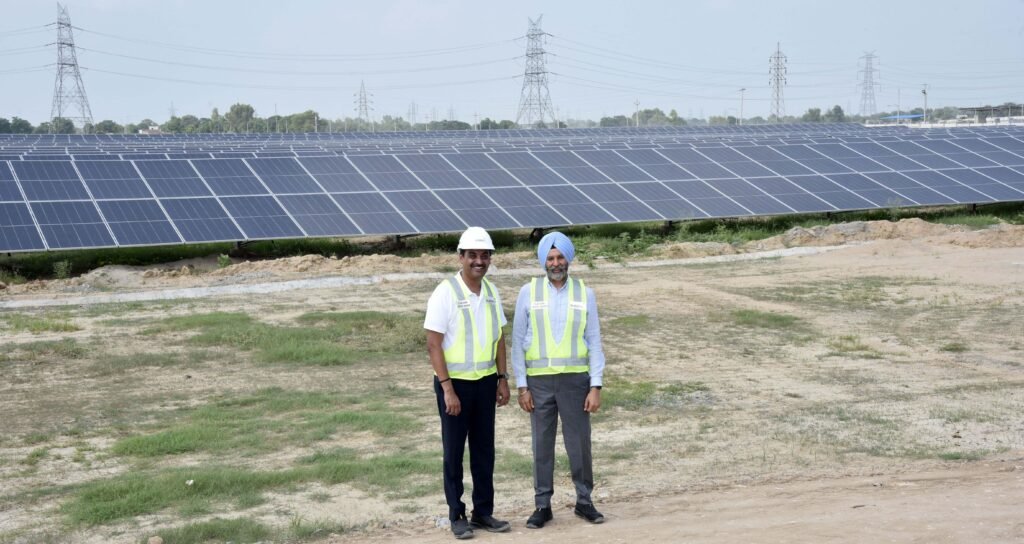
Developed and commissioned by Mahindra Susten, the 42 MWp solar project will supply renewable electricity to Swaraj Tractors’ manufacturing, assembly and foundry operations in Mohali, Punjab. Spread across approximately 141 acres, the installation comprises high-efficiency N-Type TOPCon bifacial solar modules mounted on fixed-tilt structures. The project’s residual capacity is proposed to be used to green the electricity consumption of other Mahindra Group entities located in Punjab.

Commenting on the commissioning of the project, Gaganjot Singh, Chief Executive Officer, Swaraj Division, Mahindra & Mahindra Ltd., said: “Nearly half a century ago, Swaraj was founded on the principles of self-reliance and independence. At a time when India is reducing its dependence on fossil fuels and progressing towards a greener environment for its people, Swaraj is proud to contribute through a two-pronged strategy: reducing energy consumption and progressively replacing conventional sources with renewable energy.”
Earlier this year, Swaraj was recognized with the Golden Peacock Award for Energy Efficiency. We are now complementing our energy-efficiency initiatives by sourcing more than half of our energy requirements from renewable sources. This has been made possible through our collaboration with Mahindra Susten, which has developed this state-of-the-art solar project in Bathinda, Punjab. This project strengthens our energy self-reliance, contributes to the Mahindra Group’s ambition of becoming Planet Positive and advances our vision of ‘Together We Rise for a More Equal, More Sustainable World.”
Swaraj’s sustainability journey extends beyond renewable energy adoption. In 2023, all Swaraj tractor manufacturing plants achieved EP100 certification for doubling energy productivity, seven years ahead of the Mahindra Group’s commitment timeline.
Commenting on the partnership, Avinash Rao, Managing Director and CEO, Mahindra Susten, said: “We are proud to partner with Swaraj Tractors in advancing its renewable energy transition and sustainability agenda. The commissioning of this project also marks Mahindra Susten’s maiden foray into supplying power to creditworthy commercial and industrial customers through the group captive structure, complementing our traditional model of supplying power to government utilities.”
“Among the largest group captive solar installations in Punjab at the time of commissioning, the project is expected to offset more than 42,000 tonnes of carbon dioxide emissions annually.”
Mahindra Susten is the Mahindra Group’s renewable energy platform and a leading Independent Power Producer. With a strong portfolio of operational and under-construction renewable energy projects, supported by an ambitious development pipeline, Mahindra Susten is helping advance India’s clean energy transition.
The company’s capabilities extend beyond solar energy to hybrid renewable energy solutions and Battery Energy Storage Systems, enabling reliable, flexible and future-ready renewable energy integration. Mahindra Susten is also a co-sponsor of Sustainable Energy Infra Trust, a renewable energy-focused Infrastructure Investment Trust listed on the NSE.
Swaraj contributes significantly to the Mahindra Group’s Farm Equipment Business ambition of achieving threefold revenue growth during this decade, while ensuring that performance, people and the planet progress together.
Alongside its strong growth in recent years, Swaraj has continued to invest in people development, diversity and inclusion, and community empowerment. In February 2026, Swaraj received the Golden Peacock Award for CSR Excellence for its sustained commitment to strengthening rural communities and enabling inclusive growth across India’s villages.
All Swaraj manufacturing plants are water positive and certified as Zero Waste to Landfill facilities. Swaraj’s foundry was also the first foundry operation in India to achieve Zero Waste to Landfill certification. Looking ahead, the company is focusing on reducing product-related Scope 3 emissions, accelerating supplier decarbonisation, building ESG capabilities, expanding green dealership programmes and strengthening diversity across its operations.
The Mahindra Group has received several recognitions for sustainability leadership and is regarded as one of India’s leading companies in integrating climate action and ESG principles across strategy, reporting, disclosures and implementation. Through its commitment to responsible growth, the Group continues to create long-term value for its stakeholders.
Key project facts
Located in Village Teona Pujarian, Talwandi Sabo, Bathinda, the solar facility has been developed across approximately 141 acres.
The project comprises high-efficiency N-Type TOPCon bifacial solar modules installed on fixed-tilt structures. The technology was selected to deliver higher energy output while optimising the use of available land.
The facility is expected to generate approximately 61.54 million units of renewable electricity annually and offset more than 42,000 tonnes of carbon dioxide emissions each year.
The project also reflects a strong commitment to domestic sourcing, with more than 97% of its components sourced from within India. This supports the country’s renewable energy manufacturing ecosystem and the broader vision of self-reliant growth.
Semi-automated robotic systems will be used to clean the solar modules, helping the project save an estimated 1.92 million litres of water annually.
Environmental and social impact assessments, along with a climate change assessment, were undertaken during the project’s development. Measures have also been introduced to manage waste, regulate vehicle movement and minimise disturbance to the surrounding ecology.